







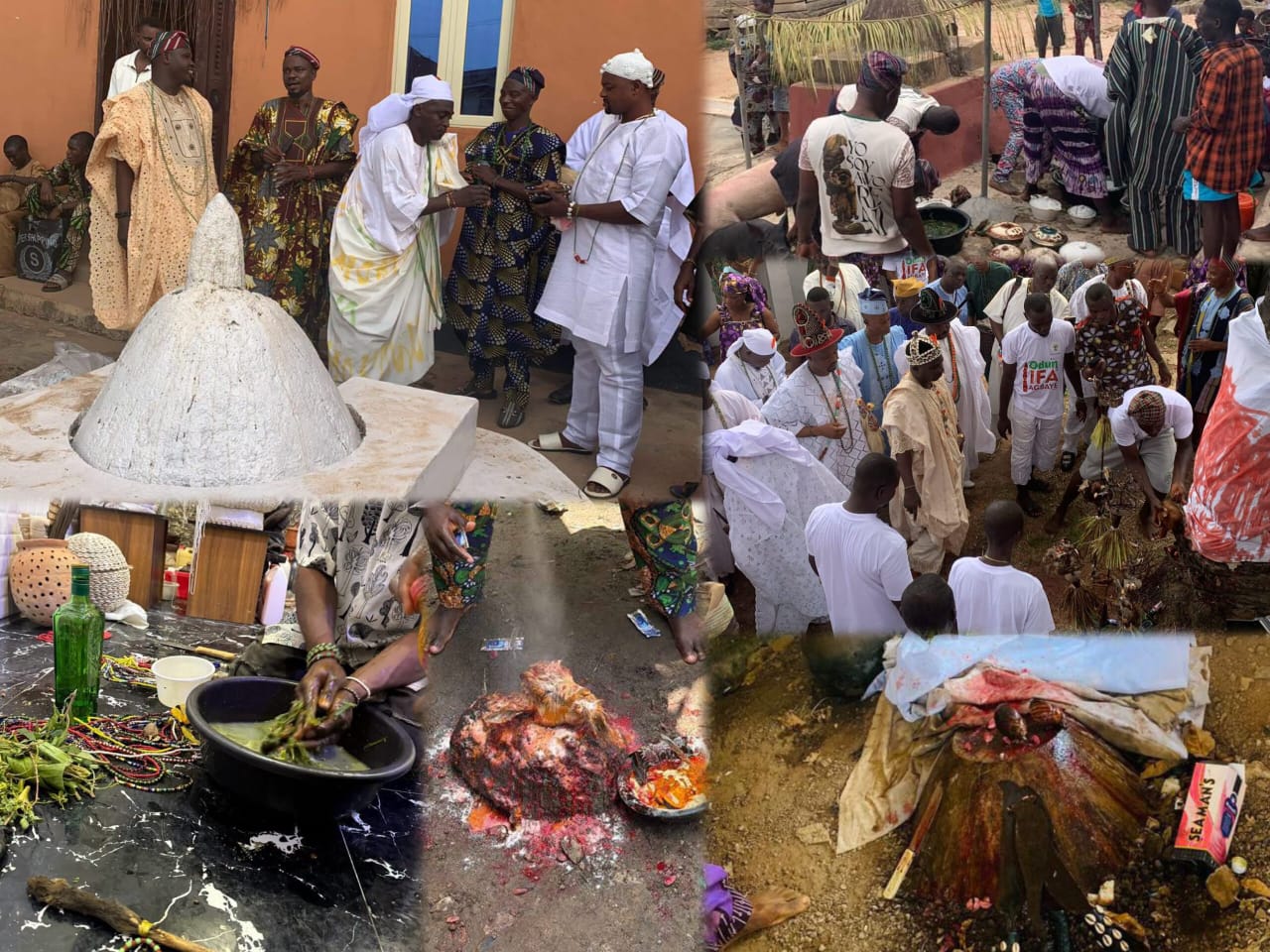
In the ancient hill town of Igbajo, there is a conversation that almost nobody wants to have in the open. It happens in compounds after nightfall, between relatives who trust each other, in the careful language of people who know that certain words carry weight that ordinary speech cannot contain. It is a conversation about power — specifically, about the kind of power that does not announce itself loudly, that does not require a temple on every street corner to make its presence felt, and that does not, by all accounts gathered during this investigation, acknowledge any authority higher than its own. That power has a name. The community calls it Orisha Olodu.

To the casual visitor, Igbajo presents the familiar face of a traditional Yoruba community — ancient compounds, sprawling family trees, the smell of red earth afterrain.But spendenough time here, speak to enough people, and a more troubling portrait begins to emerge. One shaped by fear, obligation, and the long, unrelenting reach of an ancestral deity that, according to those who know it best, plays by rules that neither Christianity nor Islam hasbeen able to rewrite. This investigation, conducted over several weeks through field visits, community interviews, and extended conversations with current and former residents,attempts to document what many in Igbajo have long known but rarely said aloud.
Few people in Igbajo speak about Olodu in public. Fewer still are willing to do so on record. Butonemanwhoagreed tospeakopenlywasa chiefpriestofthedeity fromthe Olaonipekun family, one of the lineages most historically associated with the worship and custodianship of Olodu in the community. He did not speak with the casualness of a man reciting tradition. He spoke with the gravity of someone who has watched consequences unfold in real time, across generations, within his own bloodline.
“Olodu is not something you negotiate with,” he said, seated inside the inner room of a family compound that bore the quiet, unmistakable marks of a place set apart for sacred purposes. “It does not matter what church you attend. It does not matter whether you pray five times a day facing Mecca. The moment you are born into a family that belongs to Olodu, you belong to Olodu. That is not a threat. That is simply how it is.” He paused, then added with a quiet certainty that left little room for argument: “Olodu does not respect any religion.”
What makes the accounts surrounding this deity so unsettling is not mythology alone — it isthe way its supposed consequences manifest in deeply human terms. Infertility. Infant death. Childlessness stretching across decades. The chief priest from the Olaonipekun family did not speakinvaguespiritualabstractionswhenthisreporterpressedhimonthematter.Hespoke in examples. Painful, personal, family examples that he said any elder in Igbajo could corroborate.
“I can point to my own relatives,” he said. “Sons of this family who converted — some to Christianity, some to Islam — and who, convinced by their new faith that traditional worship was sinful, walked away from their obligations to Olodu. Some of them are childless to this day.” He listedno names out of respect for those still living. But he was unambiguous about
the cause as he understood it. “They believed worshipping Olodu was against their religion. But what they did not understand is that Olodu was here long before any of those religions entered this land. You cannotuse a new faith to cancel an ancient covenant.”
When asked to name the single most feared consequence of abandoning the worship of Olodu, the chief priest did not hesitate. “The loss of a child,” he said. “That is what breaks people. That is what brings some of them back — sometimes after many years, sometimes too late.” He described cases within families connected to the Olaonipekun lineage where repeated miscarriages, stillbirths, and the deaths of young children were understood by community elders as signs of spiritual disconnection from the deity. While he did not claim this was the only possible explanation for such tragedies, he was firm that in families with obligations to Olodu, it was the first and most urgent explanation that must be examined. “Some people go to doctors,” he said. “I am not against doctors. But when the doctors find nothing wrong and the losses continue, what do you say then? The doctors have done their part. Now the family must do theirs.”
Medical professionals reached separately by Crystal Media News stressed the importance of evidence-based explanations for infertility and pregnancy loss, cautioning against interpretations that could discourage families from seeking appropriate clinical care. They acknowledged, however, that in communities where spiritual and biological explanations coexist, the former frequently carries greater emotional and social weight, often shaping how families respond to tragedy long before they consider medical intervention.
WhatgivestheaccountssurroundingOloduaparticularlychargedrelevanceintoday’s Nigeria is that its reach is not confined to families who have remained traditionally inclined. The chief priest was explicit and unhesitating on this point. Some of the families most visibly affected, in his telling, are Muslim households and Christian households — people who have,in many cases, been practising their respective faiths for a generation or more. “We have Muslims in this family,” he said. “We have Christians. Olodu does not look at what is on your head orwhatbookyoucarry.Itlooksatthecovenant.The covenantpredatesyour conversion.” Several former residents confirmed that this belief — that religious conversion offers no protection from ancestral obligations — is widely held among those who grew up in Igbajo, even among those who personally reject it.
“That was the part that was hardest to shake,” said one man now living outside Nigeria, who spoke on condition that his identity not be disclosed. “I became a Christian. I believed withmy whole heart. But there was always that voice from home saying it was not enough. That Olodu was still waiting.”
The link between these beliefs and Igbajo’s demographic decline is difficult to quantify but impossible to ignore in conversation after conversation with current and former residents. Young people have been leaving for Lagos, Ibadan, Abuja, Port Harcourt, and increasingly for destinations abroad. Many cite economic reasons, as is common across Nigeria. But a striking number also speak of something less tangible — a desire for distance from the expectations, from the obligations, from a name that seems to follow a person regardless of how far they travel.
“I did not leave because I had no love for home,” said one young graduate who departed Igbajo more than a decade ago and has not returned since. “I left because I wanted to build a life withoutthis thing hanging over it. Without someone telling me every misfortune has a
spiritualcauserootedinsomethingmygrandfatherdidordidnotdo.”Communityleaders and elders interviewed for this report acknowledged that the departure of the younger generation has left Igbajo struggling with the kind of institutional and social decline commonto communities that lose their working-age population. Schools are less full. Markets are quieter.Compoundsthatoncehousedsprawlingextendedfamiliesacrossmultiple generations now stand largely empty.
It is, however, the stories of women that cut perhaps the deepest in this investigation — women whose lives have been shaped, redirected, and in some cases effectively dismantled by their association with the Olodu lineage. Crystal Media News spoke with two women during the course of this report. One agreed to be identified. The other requested that her name not be used.
Abibat is a woman from Igbajo who spent years building a life in Abuja, the kind of life that many young Nigerians dream of — a career, independence, the possibility of a future on her own terms. But that future kept running into the same wall. Suitor after suitor would show initial interest, pursue the relationship with apparent seriousness, and then, at the point where families began to make enquiries, go silent. No confrontation. No explanation. Simply the cessation of all communication, as though she had never existed.
“It happened more times than I can count,”Abibat told our correspondent, her voice steadybut carrying the unmistakable weight of accumulated disappointment. “Once they found out which family I come from, once they understood the connection to Olodu, they would just stop. No call. No message. Nothing. Because everyone understands what it means. Everyone understands the consequences of marrying into a family connected to Olodu and then failingto fulfil the obligations.”
After years of this pattern repeating itself with no sign of changing, Abibat made the decision that she never imagined she would make. She packed up her life in Abuja and returned to Igbajo. Not in triumph. Not by choice in any meaningful sense of the word. But because the demands that Olodu had placed on her life, mediated throughthe perceptions and fears ofeverymanwhohad everwalkedawayfromherwithoutawordofexplanation,had effectively followed her to the capital and made a normal life there impossible.
“Icameback,”shesaidsimply.”WhatelsewasItodo?”
Thesecondwoman,whoaskedthathernamenotbepublishedandwhomCrystalMedia News has agreed to protect, told a story of even more devastating consequence. She hadmarried twice. Both marriages took place while she was living in Lagos, away from Igbajo, in circumstances where she had believed, perhaps hoped, that distance from home might alsomean distance from what home carried. It did not.
In her first marriage, she lost three children. Each death was medically unexplained. Doctors examined her, conducted tests, and found no clinical reason for the losses. But grief, as it so often doesin communitieswherethespiritualandthephysical arenot neatlyseparated, began to seek an explanation that medicine could not provide. Her husband’s familyeventually reached the conclusion that she was the source of the problem — that her connection to theOlodu lineage had brought misfortuneinto the home.The marriage ended.
She remarried. The second union collapsed under the pressure of the same narrative following her from the first. By the time this reporter met her, she had returned to Igbajo, closed the business she had built in Lagos, and was attempting to piece together a life from what remained.
“I am traumatised,” she said, in words that came slowly and without drama, the way words come from someone who has gone beyond the point of expecting sympathy to make a difference. “I cannot focus. I cannot plan. Every time I try to move forward, I remember what happened. I remember my children. I remember how my husbands looked at me at the end — likeIwasthecauseofeverything.Ihadtoclosemybusiness.Ihadtocomebackhere.This is where I am now.” She paused for a long moment before adding: “As for marriage, as for children I have accepted that luck is not on my side. Not with my family’s connection toOlodu.”
Yet even in the depths of that resignation, a fragment of something not quite hope, but the memory ofwhat hopeonce felt like— surfacedduring her conversation with this reporter. She recalled the counsel of her late friend’s aunt, an older woman who had lived through her ownyears ofhardship connectedtothesamelineageandwhohad,before herdeath,passed ona belief she held firmly.Theolder womanhad toldher that there was a way through.That if she could find the means to leave Nigeria entirely, to put not just distance but international bordersbetweenherselfandthereachofOlodu,shestoodachance.Thatbeyondtheshores of this country, the deity’s grip might loosen. That marriage might become possible. That children might come. That a normal life, the kind that had eluded her through two broken marriages and three buried children, was not entirely beyond reach — provided she could get far enough away.
“She told me that relocating outofNigeria completely might be the only way Icouldovercome this,” the woman said quietly. “That if I could settle abroad, build my life there, maybe Olodu would not follow me that far. She believed there was a chance. She encouraged me.” There was a long pause before she continued, and when she did, her voice carried the particularexhaustionofsomeonewhohasexaminedadoorthatwillnotopenandmade peace with the fact. “But where will I get the kind of money that requires? Travelling out of Nigeria is not a small thing. It is not something you decide and do. You need money for visa, for ticket, for accommodation, for everything. And we have nobody to support us. Nobody is coming to help. So what do I do with that advice? I hold it. And I stay here.”
ThequestionshelefthanginginthatcompoundinIgbajoisnothersalone.Itisaquestion that applies to an entire generation of young people from families connected to the Olodu lineage — young people for whom relocation abroad has been whispered about as a possible escape, a geographical solution to a spiritual problem, but who face the same brutal economic arithmetic.Howmanyofthemcanrealisticallyaffordthecostofvisas,flights, documentation, and resettlement in a foreign country? How many have the connections, the sponsors, the resources? In a community already hollowed out by decades of outward migration, where markets are quieter and compounds stand empty, the cruel irony is that the veryescaperoutethatsomeelderspointtoasasolutionrequirespreciselythekindof financial capacity that most of those left behind do not possess. The reach of Olodu, it turnsout, is enforced not only by belief but by poverty.
Perhaps the most socially charged broader consequence described by residents — current and former alike— is thegrowing reluctance of women from outsideIgbajo to marry men with
knownconnectionstoOloduworship.”It is areal thing,”saidonewomanfroma neighbouring town who spoke freely once assured her name would not appear in print. “If a man is from Igbajo and you find out his family is connected to Olodu worship, some women willsimplywalk away.Notbecauseofhimpersonally.Becauseofwhattheyfearmight follow the union.” Multiple sources described how this stigma operates — sometimes quietly, throughwhisperedconversationsbetweenmothersanddaughtersduringcourtship, sometimes more openly when families conduct their background investigations intoprospective suitors. Young men from Igbajo reported that the association, even where theyhavenopersonalinvolvementinanytraditionalpractice,caneffectivelynarrowtheir marriage prospects in ways that leave them frustrated and with little recourse.
“You carry the name of your family,” said one young man from the town. “Even if you have never participated in anything,if yoursurnameis connected to certain lineages,some families outside will not agree to the marriage. How do you fight that?”
The chief priest of the Olaonipekun family, for his part, does not frame any of this as a crisis. He frames it as a choice — one that each family and each individual must make with full awarenessthat choices carry consequences.”We arenot forcing anyone,”hesaid.”Olodu does not need to force anyone. Time does the work.” He described his role not as one of compulsion but of preservation — keeping alive a practice he believes has sustained certain families through generations of hardship, and whose absence, he is equally convinced, has contributed to the visible suffering of those who turned away.
Whether one approaches these accounts through the lens of faith, culture, psychology, or studied scepticism, what is beyond dispute is their power and their persistence. They have shapeddecisions—aboutwheretolive,whomtomarry,howtointerpretmisfortune,how far from home to run, and whether running is ever truly enough. The stories of Abibat and the woman who could not giveher name are not simplypersonal tragedies.They are,inthe context of this investigation, a measure of how deeply a community’s inherited beliefs canreach intothelives ofindividuals—determining notjust who they worship,but whothey love, where they live, and what they are permitted to become.
Igbajo remains one of Osun State’s oldest and mosthistorically significant communities. Butas its young people continue to leave, as its women return broken from cities that offered promisebut could notprotect them fromwhat they carried, and as thedebatebetween ancestral obligation and modern religious identity continues to be conducted in hushed tones behind closed doors, the town faces questions that no deity and no church and no mosque has yet been able to resolve: what does a community owe its traditions, and what do its traditions owe the community in return? And for the young people of Igbajo who carry the name ofOlodu on their backs and cannot afford the price of escape, the more immediate question is simpler and more devastating still — what happens to those who are left behind?